Is ITTT legit?
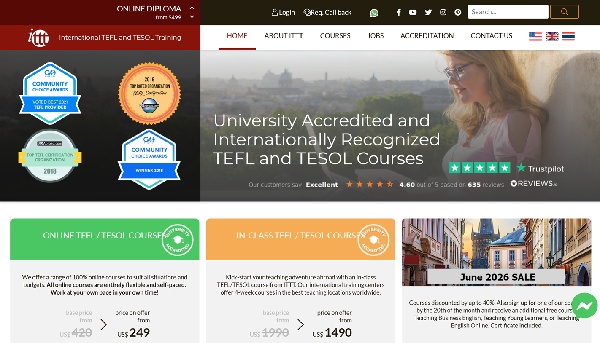
Yes, ITTT TEFL is legit according to internet evidence. Based on the information available online, ITTT appears to operate as a real TEFL course provider with public-facing course details, visible company information, student-facing support, and enough external evidence to treat it as a legitimate provider.
ITTT TEFL Review Trust Score
An editorial scoring summary for ITTT, also known as International TEFL and TESOL Training, assessing accreditation clarity, public reputation, course substance, and likely employability value under the TEFL Trust Score v1.1 model.
Classification: Basic or mixed-value certificate Long-running TEFL brand Variable course depth Not CELTA or Trinity CertTESOL
ITTT is one of the more recognizable long-running online TEFL providers. It offers a wide range of TEFL and TESOL course formats, including online courses, combined courses, and higher-hour certificate packages.
Its strongest points are brand longevity, broad course availability, and usefulness for entry-level TEFL requirements. Its weaker points are accreditation strength, inconsistent signals around external regulation, and limited evidence that the standard online certificates include mandatory assessed teaching practice with real learners.
Overview
ITTT, or International TEFL and TESOL Training, is a well-known provider in the online TEFL market. It has been active for many years and is frequently encountered by new teachers comparing affordable TEFL certification options.
ITTT’s course catalog is broad. It typically markets standard online TEFL courses, higher-hour packages, business English modules, young learner modules, online teaching modules, and sometimes combined or in-person options depending on location and availability.
For many entry-level teachers, ITTT can be enough to satisfy a basic TEFL certificate requirement, especially when the employer simply asks for a 120-hour TEFL or TESOL certificate. However, it should be viewed as a practical starter credential rather than a premium teaching qualification.
Important distinction: ITTT has stronger brand recognition than many no-name TEFL providers, but that does not automatically make its standard online certificate equivalent to CELTA, Trinity CertTESOL, a government-regulated Level 5 TEFL qualification, or a national teacher-training award.
Score Breakdown
| Category | Max | Score | Reason |
|---|---|---|---|
| Hard facts | 30 | 16 | ITTT appears to be an established provider with a defined course catalog and long-running market presence. The score is limited because its mainstream online courses do not appear to carry the strongest qualification signals: Ofqual-regulated Level 5 status, CELTA/Trinity equivalence, university credit, or mandatory assessed teaching practice with real learners. |
| Reputation and market signal | 25 | 19 | ITTT benefits from name recognition, longevity, and a large public footprint. The score is below premium-provider level because reputation is strongest in the budget-to-midrange online TEFL category rather than among highly selective employers. |
| Course quality | 25 | 16 | Course quality appears adequate for basic TEFL theory and entry-level preparation, especially for learners needing a flexible online certificate. It is capped by the typical weaknesses of largely online TEFL training: limited supervised practice, variable assessment rigor, and reliance on self-paced completion. |
| Employability signal | 20 | 14 | ITTT can likely satisfy many basic job requirements where a 120-hour TEFL certificate is enough. It is weaker for selective employers, formal academic roles, visa-sensitive contexts, or jobs asking specifically for CELTA, Trinity CertTESOL, observed teaching practice, or regulated Level 5 status. |
| Total | 100 | 65 | Basic or mixed-value certificate. |
Detailed Assessment
1. Hard Facts: 16 out of 30
ITTT scores moderately on hard facts because it is not an anonymous provider. It has a visible public presence, recognizable course branding, and a wide catalog of TEFL and TESOL training options. This gives it more credibility than short-lived websites selling extremely cheap instant certificates.
The limitation is the strength of the underlying qualification. ITTT’s standard certificates appear to sit mainly in the private online TEFL market. That is useful for some jobs, but it is not the same as holding a qualification from a regulated awarding body or a globally benchmarked teacher-training route such as CELTA or Trinity CertTESOL.
Main hard-facts limitation: ITTT’s ordinary online certificates should not be assumed to be government-regulated, Level 5 equivalent, CELTA-equivalent, or based on mandatory supervised teaching practice with real learners.
Some ITTT course options may provide more tutor support, extra modules, or combined practical elements. Those may be more useful than the simplest self-paced option. Still, when scoring the provider overall, the standard online TEFL certificate remains a basic-to-midrange credential rather than a high-trust professional qualification.
| Subcategory | Max | Score | Notes |
|---|---|---|---|
| Regulated qualification status | 15 | 6 | Recognizable private TEFL provider, but no strong signal that the mainstream certificate is an Ofqual-regulated Level 5 qualification, CELTA, Trinity CertTESOL, or university-backed credential. |
| Real teaching practice | 10 | 5 | Some course formats may be more practical than others, but the standard online pathway does not clearly require assessed teaching practice with real ESL students. |
| Legal and institutional transparency | 5 | 5 | Long-running public-facing provider with an identifiable course catalog and market presence. |
| Total | 30 | 16 | More credible than obscure providers, but below regulated or practicum-heavy qualifications. |
2. Reputation and Market Signal: 19 out of 25
ITTT scores relatively well for reputation because it is one of the more visible names in the TEFL certification market. Longevity matters: providers that have operated for many years with an ongoing student base generally offer more confidence than recently created certificate sites.
ITTT’s review and market footprint suggests that many students have used its certificates for entry-level teaching applications. This is a meaningful positive signal for people whose main goal is to check the 120-hour TEFL requirement box.
The reputation score is not higher because visibility is not the same as selectivity. A provider can be popular and still offer a certificate that is academically lighter than CELTA, Trinity CertTESOL, or a regulated Level 5 qualification. ITTT’s reputation is strongest among budget and flexible online TEFL options.
| Subcategory | Max | Score | Notes |
|---|---|---|---|
| Independent review density | 10 | 8 | Large online footprint and broad student-review presence compared with smaller TEFL providers. |
| Employer recognition signal | 10 | 7 | Likely familiar enough for many entry-level employers, but not a premium qualification signal for selective schools. |
| Cross-platform consistency | 5 | 4 | Generally consistent positioning as a flexible TEFL/TESOL provider, though course pathways and accreditation messaging may require careful reading. |
| Total | 25 | 19 |
3. Course Quality: 16 out of 25
ITTT appears capable of delivering a basic TEFL foundation. A standard course will likely cover common topics such as lesson planning, grammar awareness, teaching methods, classroom management, student levels, and English-language skills.
This can be useful for new teachers, especially those who want a flexible, affordable introduction to TEFL before applying for entry-level online or overseas teaching work.
Course-quality note: ITTT may be good enough for introductory TEFL theory, but learners should not assume that completing an online course is the same as receiving intensive supervised classroom training.
Course quality is capped because the strongest teacher-training courses usually include external moderation, rigorous trainer feedback, substantial written assignments, and assessed teaching practice with real learners. ITTT’s standard online courses do not clearly meet that higher bar.
| Subcategory | Max | Score | Notes |
|---|---|---|---|
| Instructional depth | 10 | 7 | Likely adequate for beginner-level TEFL theory and core methodology. |
| Learning format richness | 5 | 3 | Flexible online delivery is convenient, but less rich than blended or supervised practicum-based training. |
| Assessment rigor | 5 | 3 | Assessment may be sufficient for course completion, but appears less rigorous than externally regulated or CELTA/Trinity-style assessment. |
| Time-on-task realism | 5 | 3 | Higher-hour course bundles can be useful, but online-hour claims should be interpreted cautiously unless assessment and workload are clearly documented. |
| Total | 25 | 16 |
4. Employability Signal: 14 out of 20
ITTT’s certificate may work well enough for many entry-level teaching roles, especially jobs where a 120-hour TEFL certificate is treated as a checkbox requirement. This includes some online teaching companies, lower-barrier language schools, volunteer programs, internships, and private tutoring contexts.
Employability will still depend on the whole candidate profile. A bachelor’s degree, previous teaching experience, strong interview performance, high-level English proficiency, and eligibility for a work visa will often matter more than the brand name of a basic online TEFL certificate.
ITTT is less suitable if the candidate is targeting competitive employers or markets where stronger credentials are expected. If a job description specifically requests CELTA, Trinity CertTESOL, observed teaching practice, a regulated Level 5 qualification, or a teaching license, ITTT’s standard online certificate may not be enough.
Employability caveat: ITTT can help with basic entry-level applications, but it should not be relied on as a strong credential for selective schools, formal academic institutions, or long-term teaching-career progression.
| Subcategory | Max | Score | Notes |
|---|---|---|---|
| Job acceptance | 10 | 7 | Likely acceptable for many entry-level jobs where a standard 120-hour TEFL certificate is enough. |
| Visa or formal requirements acceptance | 5 | 3 | May help where TEFL certification is requested, but weaker than regulated or government-recognized training for formal documentation contexts. |
| Upgrade path value | 5 | 4 | Useful as a starter credential before upgrading later to CELTA, Trinity CertTESOL, a regulated Level 5 course, DELTA, DipTESOL, or a teaching license. |
| Total | 20 | 14 |
Final Rating
| Score Band | Meaning | ITTT Result |
|---|---|---|
| 85 to 100 | High-trust qualification | No |
| 70 to 84 | Solid TEFL provider | No |
| 50 to 69 | Basic or mixed-value certificate | Yes |
| 0 to 49 | Low-trust or marketing-heavy course | No |
Bottom Line
ITTT estimated score: 65 out of 100.
ITTT is a recognizable and long-running TEFL provider that may be suitable for people who need an affordable online TEFL certificate for entry-level teaching work. It is stronger than many obscure low-cost certificate providers because it has brand history, course variety, and a larger public footprint.
The main caution is that ITTT’s standard online certificates appear to be basic-to-midrange TEFL credentials, not premium teacher-training qualifications. They should not be assumed to carry the same value as CELTA, Trinity CertTESOL, an Ofqual-regulated Level 5 qualification, or training with substantial assessed classroom practice.
In plain terms: ITTT is probably acceptable if your employer only requires a standard 120-hour TEFL certificate. It is not the best choice if you need a high-trust, regulated, practicum-heavy, or highly selective qualification.
Before buying, verify:
- Whether your target employer accepts ITTT specifically.
- Whether the course is at least 120 hours.
- Whether the certificate says TEFL, TESOL, or both.
- Whether the course includes tutor-marked assignments or mainly automated testing.
- Whether any claimed accreditation is private accreditation or government-regulated qualification status.
- Whether the course includes real observed teaching practice or only theory-based tasks.
- Whether the certificate includes verification details for employers.
- Whether job support means real placement support, a jobs board, or general application advice.
- Refund terms, course-access limits, extension fees, certificate-shipping fees, and upgrade costs.
- Whether your target country or employer requires a degree, CELTA, Trinity CertTESOL, Level 5 status, or observed practicum.
Method note: This TEFL Trust Score is an editorial scoring framework. Brand longevity, public reviews, and course variety improve the score, but they are weighted below government-regulated status, CELTA/Trinity recognition, external moderation, and substantial observed teaching practice with real learners.