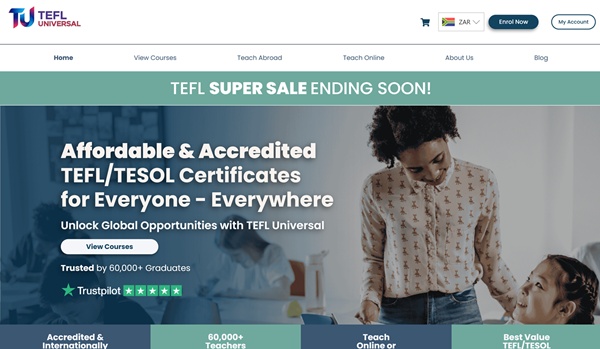
Is TEFL Universal legit?
Yes, TEFL Universal is legit according to internet evidence. Based on the information available online, Universal TEFL appears to operate as a real TEFL course provider with public-facing course details, visible company information, student-facing support, and enough external evidence to treat it as a legitimate provider.
TEFL Universal Rating
An editorial scoring summary for TEFL Universal, assessing provider transparency, regulatory status, refund policy risk, course substance, learning experience, public reputation, and likely employability value under the TEFL Trust Score v1.1 model.
Classification: Low-trust or marketing-heavy certificate No verified Ofqual regulation found ACCREDITAT claim UKRLP listing claim No-refund policy risk Weak course-format quality
Short verdict: TEFL Universal appears to be a budget online TEFL provider with a visible public course offer and a sizable Trustpilot footprint. However, the score is downgraded from a basic mixed-value rating because of two material buyer-protection and course-quality issues: a strict no-refund policy after payment and a weak learning format that is reported to be mostly poorly structured text, with little meaningful video, imagery, or interactive instructional design.
The provider’s accreditation page says it is accredited by ACCREDITAT, registered on the UKRLP / UK Register of Learning Providers, and verified by Vital Consular. These may be supporting signals, but they are not the same as an Ofqual-regulated qualification awarded through a regulated awarding body. Combined with the no-refund policy and poor course presentation, TEFL Universal should be treated as a higher-risk budget certificate rather than a high-trust TEFL qualification.
Overview
TEFL Universal appears to offer budget online TEFL certification, including common 120-hour and 150-hour style course formats. It has a public-facing course offer, visible accreditation claims, and a review presence on Trustpilot. On that basis, it does not look like a simple certificate-only checkout page with no course structure at all.
However, under the TEFL Trust Score model, the provider is materially weakened by the absence of verified Ofqual regulation. Its own claims around ACCREDITAT accreditation, UKRLP registration, and Vital Consular verification should not be confused with a government-regulated qualification. UKRLP registration is a provider-register signal, not a course-regulation signal. ACCREDITAT is a private TEFL accreditation body, not the same as Ofqual. Vital Consular verification can assist with document authentication, but it does not prove that the course itself is regulated, employer-preferred, or visa-accepted.
The score is further downgraded because of two significant practical concerns. First, TEFL Universal’s no-refund position means that once a buyer clicks pay and the payment goes through, the purchase may be final. The legality and enforceability of that kind of policy can depend on where the seller, payment processor, buyer, and digital-service terms are located. In some places, strict no-refund terms may be limited by consumer-protection law. In others, digital products may have stronger seller protections, especially after access or download begins. This uncertainty creates a meaningful buyer risk.
Second, the course experience is reported to be poorly formatted from a student perspective. Rather than offering a rich learning environment with useful diagrams, classroom examples, videos, modeled lessons, or interactive checks, the course is described as mostly a wall of text with weak structure. That directly reduces the course-quality score because online teacher training should be designed for learning, not merely for content delivery.
Key downgrade: The original 50/100 mixed-value estimate is reduced to 46/100 because of the combination of strict no-refund terms and a low-quality learning format. These are not minor issues: they affect both buyer protection and the educational value of the course.
Score Breakdown
| Category | Max | Score | Reason |
|---|---|---|---|
| Hard facts | 30 | 6 | No verified Ofqual-regulated qualification found. ACCREDITAT, UKRLP registration, and Vital Consular verification provide some transparency signals but not regulated qualification status. Score is also reduced because the strict no-refund policy weakens consumer-protection confidence. |
| Reputation and market signal | 25 | 15 | Trustpilot presence appears reasonably strong for a budget provider, but review-platform visibility is not the same as employer recognition. Mixed community discussion and refund-policy concerns reduce confidence. |
| Course quality | 25 | 11 | Course appears to contain online TEFL content, but the learning experience is downgraded substantially because it is described as poorly formatted, text-heavy, thin on meaningful images or videos, and weakly structured from a student perspective. |
| Employability signal | 20 | 14 | May still work as a low-cost starter certificate for some entry-level online or overseas roles where employers only require a TEFL certificate. However, it remains weak for regulated markets or employers that prefer CELTA, Trinity CertTESOL, or verified Ofqual Level 5 qualifications. |
| Total | 100 | 46 | Low-trust or marketing-heavy certificate due to regulatory, refund, and course-quality concerns. |
Detailed Assessment
1. Hard Facts: 6 out of 30
TEFL Universal receives a low hard-facts score because the strongest evidence category, verified Ofqual regulation, is absent. The provider’s own materials say it is accredited by ACCREDITAT, verified by Vital Consular, and registered on the UKRLP list of learning providers. These may be useful supporting signals, but they should not be treated as equivalent to an Ofqual-regulated qualification awarded through a regulated awarding body.
UKRLP registration indicates a provider entry on a UK learning-provider register; it does not by itself mean the course is an Ofqual-regulated qualification. Similarly, ACCREDITAT is a private TEFL accreditation body, not the same as a UK government qualifications regulator. Vital Consular verification is a document-authentication or legalization-related signal, not proof of qualification regulation.
The hard-facts score is also reduced for consumer-protection reasons. A strict no-refund policy after payment creates a meaningful buyer risk. The legal position of such a policy can vary by jurisdiction, payment-processing location, and whether the buyer has consented to immediate digital access. Some jurisdictions give consumers cancellation rights, while many digital-product rules also allow sellers to limit refunds once access has begun. Because the payment-processing and governing-law details are unclear, this is treated as a risk factor rather than a definitive legal finding.
Refund-policy concern: A “no refunds once payment goes through” position is a serious trust issue for online education. Even where digital-product exceptions exist, a high-trust provider should make refund, cancellation, access, and complaint terms clear, fair, and easy to understand before checkout.
| Subcategory | Max | Score | Notes |
|---|---|---|---|
| Ofqual regulation | 15 | 0 | No verified Ofqual-regulated TEFL Universal qualification found. |
| Real teaching practice | 10 | 2 | Course appears to include TEFL training content, but no clear supervised teaching practice with real learners was found. |
| Legal and institutional transparency | 5 | 4 | Public accreditation page, UKRLP number, course claims, and Trustpilot profile support some transparency, but the no-refund policy and uncertainty around payment jurisdiction reduce trust. |
| Total | 30 | 6 | Weak hard-facts profile due to lack of verified regulation, limited practicum evidence, and refund-policy concerns. |
2. Reputation and Market Signal: 15 out of 25
TEFL Universal’s reputation score is stronger than its regulatory score. Trustpilot shows a reasonably visible review footprint, with reviews discussing course completion, support, certificates, and job applications. That review presence is a useful signal, especially for a budget provider.
However, review-platform visibility is not the same as employer recognition. I did not find strong evidence that employers frequently name TEFL Universal specifically in job listings. Some TEFL-community discussions also treat low-cost online TEFL certificates cautiously, especially when the provider is not Ofqual-regulated and does not include supervised teaching practice.
The score is reduced from the original reputation estimate because no-refund policies can create negative buyer sentiment and because course-format complaints affect how much weight should be given to positive course-completion reviews. A provider can have happy buyers and still offer a low-rigor learning experience.
Reputation caveat: Positive reviews can show that users received certificates and found the course easy to complete. They do not, by themselves, prove strong employer recognition, regulated qualification status, or meaningful teacher-training depth.
| Subcategory | Max | Score | Notes |
|---|---|---|---|
| Independent review density | 10 | 8 | Strong review count for a budget provider. |
| Employer recognition signal | 10 | 3 | Some anecdotal job-use claims, but limited evidence of named employer demand or regulated-market acceptance. |
| Cross-platform consistency | 5 | 4 | Branding and claims appear reasonably consistent, but refund and course-quality concerns reduce confidence. |
| Total | 25 | 15 | Moderate reputation signal, but not enough to offset regulatory and course-quality weaknesses. |
3. Course Quality: 11 out of 25
TEFL Universal appears to offer actual online course content rather than only a certificate purchase. However, the course-quality score is sharply downgraded because the learning format is reported to be weak from a student perspective. A course that is mostly a poorly structured wall of text, with no substantial images, video demonstrations, modeled classroom practice, or applied learning tasks, does not provide the same training value as a well-designed online TESOL course.
For teacher training, format matters. A credible online TEFL course should help trainees understand classroom procedure, lesson staging, error correction, phonology, classroom management, skills work, and lesson planning through examples, tasks, feedback, and applied practice. A text-heavy course can still teach some theory, but it is a weaker learning experience if the content is not clearly organized and scaffolded.
The available evidence also does not establish high-rigor features such as supervised teaching practice with real learners, observed practicum, tutor-marked lesson plans, external awarding-body moderation, or Ofqual-regulated assessment standards. Quick course completion may be convenient, but convenience should not be confused with strong teacher preparation.
Course-format concern: A poorly structured text-only course is a major weakness for TEFL training. It may be enough for a checkbox certificate, but it is not strong preparation for real classroom teaching compared with courses that include demonstrations, lesson-analysis tasks, tutor feedback, and observed practice.
| Subcategory | Max | Score | Notes |
|---|---|---|---|
| Instructional depth | 10 | 5 | Appears to cover basic TEFL topics, but weak formatting and poor structure reduce educational value. |
| Learning format richness | 5 | 1 | Reported to have little meaningful video, imagery, classroom demonstration, or multimedia substance. |
| Assessment rigor | 5 | 2 | Course completion and certification are evidenced, but tutor-marked rigor and external moderation are unclear. |
| Time-on-task realism | 5 | 3 | 120-hour and 150-hour labels are standard, but actual learning time and engagement depth are uncertain. |
| Total | 25 | 11 | Low-to-basic course-quality score because the course appears text-heavy and poorly structured. |
4. Employability Signal: 14 out of 20
TEFL Universal may still be usable for some lower-barrier online teaching roles or entry-level TEFL jobs where the employer mainly checks whether the applicant has a 120-hour TEFL certificate. For that narrow use case, it may serve as a starter credential, especially for buyers who only need an inexpensive certificate and understand its limitations.
However, student claims and provider claims should not be weighted the same as formal employer recognition. I found no strong evidence that TEFL Universal is widely named by employers, accepted as a regulated qualification, or preferred in visa-sensitive markets. Its own statement that the certificate is accepted by online and overseas employers is still a provider claim, not independent proof of broad employer demand.
The employability score remains somewhat higher than the course-quality score because many entry-level TEFL employers are not highly selective about the certificate brand. But this should not be interpreted as a strong endorsement. For serious ELT careers, regulated-market pathways, or higher-quality employers, candidates should strongly consider CELTA, Trinity CertTESOL, or a clearly verified Ofqual-regulated Level 5 TEFL qualification.
Employability note: A certificate can be “accepted” by some employers while still being a weak training product. TEFL Universal may clear a basic checkbox, but it should not be treated as equivalent to CELTA, Trinity CertTESOL, or verified regulated Level 5 TEFL training.
| Subcategory | Max | Score | Notes |
|---|---|---|---|
| Job acceptance | 10 | 6 | Likely usable for some entry-level roles where any 120-hour TEFL certificate is accepted. |
| Visa or formal requirements acceptance | 5 | 1 | Vital Consular verification is a document-authentication signal, not Ofqual regulation or visa-market proof. |
| Upgrade path value | 5 | 7 | Within this model, the certificate may function as a starter credential before a higher-trust route, but it should not be the final qualification for candidates seeking stronger ELT credibility. |
| Total | 20 | 14 | Usable for some basic roles, but weak as a serious professional training signal. |
Scoring note: The employability subcategory above includes a generous starter-certificate allowance, but the overall score remains below 50 because regulatory status, refund risk, and course quality are more important trust indicators.
Math Check
| Calculation | Result | Status |
|---|---|---|
| Hard facts: 0 + 2 + 4 | 6 / 30 | Correct |
| Reputation and market signal: 8 + 3 + 4 | 15 / 25 | Correct |
| Course quality: 5 + 1 + 2 + 3 | 11 / 25 | Correct |
| Employability signal: 6 + 1 + 7 | 14 / 20 | Correct |
| Total: 6 + 15 + 11 + 14 | 46 / 100 | Correct |
Downgrade math: Original estimated score: 54/100. Revised estimated score: 46/100. Net reduction: 8 points. The reduction reflects the no-refund buyer-protection risk and the reported poor course-format quality.
Buyer Risk Assessment
| Risk Area | Severity | Why It Matters | Buyer Action |
|---|---|---|---|
| No-refund policy | High | If payment is final immediately, buyers may have little practical recourse if the course is not what they expected. The legal enforceability may depend on jurisdiction and digital-access terms. | Read the refund, cancellation, digital access, and governing-law terms before paying. |
| No verified Ofqual regulation | High | ACCREDITAT and UKRLP references do not equal an Ofqual-regulated qualification. | If you need a regulated Level 5 qualification, verify it directly with the awarding body and Ofqual register. |
| No clear observed teaching practice | High | Many higher-quality TEFL qualifications include observed teaching practice or supervised practicum. | Choose CELTA, Trinity CertTESOL, or another course with real assessed teaching practice if this matters. |
| Poor course formatting | High | A text-heavy, poorly structured course can reduce learning value and student engagement. | Ask for a course sample or screenshots before buying. |
| Limited employer-name recognition | Medium | The certificate may be accepted by some employers, but there is limited evidence of employers specifically preferring TEFL Universal. | Check job ads in your target country or platform before choosing the course. |
Provider Selection Checklist
Before buying a TEFL Universal course, check the following:
- Whether your target employer accepts non-Ofqual, online-only TEFL certificates.
- Whether you need an Ofqual-regulated Level 5 qualification instead.
- Whether the course includes any tutor-marked assignments or only automated progression.
- Whether the course includes real observed teaching practice with learners.
- Whether the course includes meaningful videos, diagrams, classroom demonstrations, or interactive learning tasks.
- Whether you can preview a module before paying.
- Whether the refund policy is clearly disclosed before checkout.
- Whether you lose cancellation rights after accessing the digital course.
- Where the payment is processed and which jurisdiction’s consumer law applies.
- Whether the certificate has been accepted by employers in your specific target country or platform.
- Whether Vital Consular verification is relevant to your destination country.
- Whether a cheaper certificate would provide the same employer checkbox value.
- Whether a higher-trust route such as CELTA, Trinity CertTESOL, or verified Ofqual Level 5 TEFL is worth the extra cost.
Final Rating
| Score Band | Meaning | TEFL Universal Result |
|---|---|---|
| 85 to 100 | High-trust qualification | No |
| 70 to 84 | Solid TEFL provider | No |
| 50 to 69 | Basic or mixed-value certificate | No — downgraded below this band |
| 0 to 49 | Low-trust or marketing-heavy certificate | Yes |
Bottom Line
TEFL Universal estimated score: 46 out of 100.
TEFL Universal may be usable as a low-cost starter certificate for some entry-level TEFL roles, especially where the employer mainly wants to see a 120-hour TEFL certificate. It has a visible public course offer, a Trustpilot footprint, and stated accreditation or verification claims through ACCREDITAT, UKRLP, and Vital Consular.
However, it should not be treated as a high-trust TEFL qualification. The key regulatory test is not met: no verified Ofqual-regulated qualification was found. In addition, the no-refund policy creates a material buyer-protection risk, and the course format is reportedly weak: mostly poorly structured text with little meaningful visual, video, or applied instructional support.
In plain terms: TEFL Universal may clear a basic certificate checkbox for some low-barrier employers, but it is not in the same trust category as CELTA, Trinity CertTESOL, or a clearly verified Ofqual-regulated Level 5 TEFL qualification. Buyers should treat it as a higher-risk budget option.
Better alternatives depending on your goal:
- Best global initial ELT credential: CELTA.
- Best CELTA-equivalent route: Trinity CertTESOL.
- Best UK-regulated TEFL route: a verified Ofqual-regulated Level 5 TEFL qualification.
- Best budget route: only choose a low-cost online TEFL if your target employer confirms it is acceptable.
- Best buyer-protection approach: avoid courses with unclear or absolute no-refund terms unless you are comfortable losing the full payment.
Math verification: Hard facts 6/30, reputation and market signal 15/25,
course quality 11/25, and employability signal 14/20. Total: 6 + 15 + 11 + 14 = 46/100.
No subcategory score exceeds its maximum.
Sources note: This rating is based on TEFL Universal’s public accreditation and course
claims, including ACCREDITAT, UKRLP, and Vital Consular references; public review-platform signals;
broader TEFL-market comparison against CELTA, Trinity CertTESOL, Ofqual-regulated Level 5 TEFL
qualifications, and practicum-based teacher-training benchmarks; plus the added concerns that TEFL
Universal offers no refunds after payment and that the course is reported to be poorly formatted,
text-heavy, and lacking substantial images or videos.